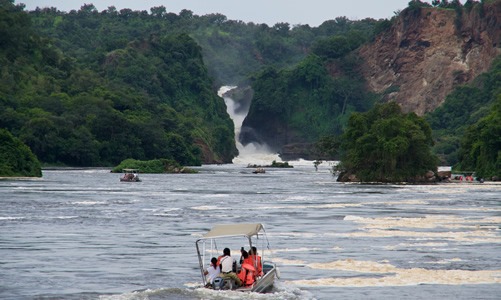
A classic, action-packed one-week safari in Uganda—the Pearl of Africa—hits the top highlights: chimpanzee trekking in Kibale Forest, wildlife viewing in Queen Elizabeth National Park, and mountain gorilla trekking in Bwindi Impenetrable National Park.
Tour highlights for 7 Days safari in Uganda
Entebbe arrival transfer
Emerald tea plantations
Forest chimpanzee tracking
Bigodi wetland birding
Tree climbing lions
Savannah game drives
Kazinga boat cruise
Mighty hippo sightings
Misty terraced highlands
Mountain gorilla trekking
Cultural center lunch
Equator monument crossing
Day by day on 7 Days safari in Uganda
Day 1: Arrival & Travel to Kibale National Park
Your highly anticipated 7 Days safari in Uganda begins the moment you touch down at Entebbe International Airport. Photographers can choose to board a brief, highly scenic one-hour domestic flight over the changing landscapes or embark on a captivating five-to-six-hour overland drive toward Fort Portal. Moving away from the urban center, the scenery transitions into rolling emerald hills, rural villages, and extensive tea plantations that carpet the landscape. This drive provides immediate opportunities for capturing vibrant environmental portraits and local lifestyle shots through your lens. As you approach the massive Rwenzori Mountain foothills, the dramatic topography creates a striking backdrop for wide-angle landscape photography. You will eventually arrive at the edge of Kibale National Park, the acclaimed primate capital of the world. Check into your forest lodge, prepare your camera equipment for low-light forest environments, and fall asleep to the unique acoustic symphony of the ancient tropical rainforest.
Day 2: Chimpanzee Tracking & Bigodi Wetland
The second day of this premier one-week holiday vacation brings you face-to-face with wild primates. You will head deep into Kibale Forest for a morning chimpanzee tracking adventure. The thick canopy creates moody, diffused lighting, requiring fast lenses and high ISO settings to freeze the quick movements of the chimps as they swing through branches. Capturing the expressive, human-like eyes of a chimpanzee against the dark green foliage is an absolute portfolio highlight. In the afternoon, the perspective shifts during a guided walk through the community-run Bigodi Wetland Sanctuary. This swamp ecosystem is a paradise for macro and bird photography. Keep your telephoto lens ready to capture the vibrant plumage of the Great Blue Turaco and the distinct features of various monkey species, including grey-cheeked mangabeys and red colobus monkeys, navigating the reeds. Return to the lodge to back up your incredible primate images.
Day 3: Travel to Queen Elizabeth National Park
Your 7 Days safari in Uganda continues as you journey south toward Queen Elizabeth National Park, a land of diverse ecosystems. The three-to-four-hour drive guides you along the scenic edge of the Albertine Rift Valley, offering panoramic vistas of crater lakes and savannah plains. The definitive photographic highlight of the day occurs in the afternoon as you enter the remote Ishasha sector. This unique region is globally famous for its tree-climbing lions, which lounge lazily on the low branches of ancient fig trees to escape the ground heat. Spotting these massive apex predators draped over limbs offers an incredible, distinct composition that contrasts sharply with traditional ground-based wildlife portraits. Frame these regal cats against the textured bark and vibrant green leaves using a versatile telephoto zoom. As dusk approaches, the soft golden hour light paints the savannah in warm tones, concluding a remarkable day of wilderness photography.
Day 4: Kazinga Channel Boat Cruise & Game Drive
Day four of this unforgettable one-week holiday vacation features a brilliant combination of savannah and aquatic photography. An early morning game drive through the Kasenyi plains allows you to capture elephants, leopards, and Uganda kobs under pristine, golden morning light. Your guide will position the vehicle to maximize front-lighting on the wildlife against the vast, open horizon. In the afternoon, you will embark on a customized boat cruise along the famous Kazinga Channel. This natural waterway connects Lake Edward and Lake George, boasting one of the world's highest concentrations of hippos. From the stable water platform, photographers can achieve spectacular low-angle shots of yawning hippos, massive Nile crocodiles basking along the banks, and diverse waterbirds like skiming pelicans and colorful kingfishers. The unique reflections on the water and the proximity to the animals guarantee exceptional, high-impact wildlife imagery.
Day 5: Journey to Bwindi Impenetrable Forest
Your spectacular 7 Days safari in Uganda climbs into the clouds today as you depart for Bwindi Impenetrable National Park. The four-to-five-hour drive transitions from open savannah plains into the stunning, tightly terraced hillsides of the Kigezi Highlands, affectionately known as the "Switzerland of Africa." This drive is a visual masterpiece for landscape photographers. Layers of steep hills fade into the distance, often draped in dramatic morning mist and low-hanging clouds that create depth and mood in wide-angle compositions. Watch for local farmers working the terraced plots, offering beautiful opportunities for storytelling travel photography that showcases the deep relationship between the people and their land. As you ascend toward the ancient forest sectors, the air turns cool and crisp. You will arrive at your mountain lodge by afternoon, perfectly positioned at the threshold of the mysterious, ancient gorilla habitat.
Day 6: Mountain Gorilla Trekking
The pinnacle event of this exclusive one-week holiday vacation arrives with the bucket-list gorilla trekking experience in Bwindi. Entering the dense, primeval rainforest alongside expert trackers, you will navigate tangled vines and steep ridges to locate a wild mountain gorilla family. Once found, you are permitted one unforgettable hour to observe and photograph these magnificent gentle giants up close. The dense forest canopy presents challenging, high-contrast dappled light, making spot metering on their thick black fur essential to preserve intricate facial textures and deep expressions. Photographing a massive silverback alpha guarding his family or young infants playing in the foliage provides unparalleled emotional weight to your portfolio. This intimate encounter blends technical skill with raw artistic storytelling, producing powerful images that capture the true essence of conservation. It remains a deeply transformative experience for any wildlife photographer.
Day 7: Return to Entebbe via the Equator
The final chapter of your 7 Days safari in Uganda features a scenic eight-hour return journey back toward Kampala and Entebbe. Leaving the misty highlands behind, you will travel through the rolling hills of Ankole, famous for its iconic long-horned cattle. Keep your camera accessible for roadside snapshots of these majestic animals and bustling local markets. Break up the drive with a lunch stop at the Igongo Cultural Centre to photograph historical exhibits, followed by a classic stop at the Equator monument in Kayabwe. Here, you can capture fun memory photos standing in both the northern and southern hemispheres simultaneously. Arrive in Entebbe by late afternoon or early evening, giving you sufficient time to pack your gear and process your files before your international departure flight. You leave with an extraordinary collection of images showcasing Uganda's diverse landscapes and remarkable wildlife.
1. Which specific camera lens system balances the needs of rainforest primate tracking and open savannah game drives?
Executing a world-class portfolio during your one-week holiday vacation requires a highly strategic, dual-body camera kit to eliminate field lens changes. In the dense, dark primary forest of Kibale and Bwindi, an f/2.8 telephoto zoom lens (ideally a 70–200mm f/2.8) is your absolute lifeline. The fast f/2.8 constant aperture is non-negotiable; it maximizes light transmission under multi-layered, dim forest canopies where ambient light can drop by up to eighty percent. This focal range perfectly covers the mandatory seven-to-ten-meter viewing perimeter, allowing tight facial framing of silverbacks or chimpanzees without clipping their frames.
Conversely, when transitioning to the sweeping savannahs and wide water channels of Queen Elizabeth National Park, your priority shifts from maximum light gathering to maximum optical reach. Here, a super-telephoto zoom lens such as a 100–400mm or 200–600mm becomes your primary workhorse. This range allows you to isolate a leopard draped on an acacia branch or capture low-angle action shots of swimming elephants along the Kazinga Channel shores.
Complementing these long lenses with a wide-angle zoom (such as a 24–70mm f/2.8) on your second body is vital for capturing environmental portraits. This lens allows you to instantly pivot to document the stunning, misty terraced ridges of the Kigezi Highlands or frame a wild gorilla within the vast context of its primordial jungle home.
2. How should exposure strategies change when moving from high-contrast savannahs to deep, light-absorbing jungle canopies?
Navigating the extreme exposure variations across Uganda's distinct biomes requires a deep understanding of your camera’s sensor limits. Out on the open plains of Queen Elizabeth National Park, light is abundant but harsh. Your primary challenge is controlling intense dynamic range during mid-day drives, preventing blown-out highlights on pale grasses or animal hides. You will typically operate in Aperture Priority or Manual mode at lower ISO settings (100 to 400), utilizing sharp mid-range apertures (f/5.6 to f/8) to optimize edge-to-edge resolution.
The moment you enter Bwindi Impenetrable Forest or Kibale Forest, those rules are completely rewritten. Because flash photography is strictly banned to protect animal welfare, you must embrace high ISO settings. The most reliable technical baseline for forest primate photography is utilizing Manual Mode with Auto ISO, locking your shutter speed at a minimum of 1/250s for resting primates or 1/500s for active, swinging chimpanzees. Set your aperture wide open (f/2.8 or f/4) to draw in light, and let the camera dynamically float the ISO between 1600 and 6400.
Crucially, switch your camera’s metering to Spot Metering and lock it onto the primate's face. Evaluative metering will inevitably get fooled by the bright, backlit pockets of sky piercing through the leaves, forcing the camera to underexpose the dark fur into an empty silhouette. Spot metering ensures the intricate skin wrinkles, facial expressions, and deep amber eye details are perfectly exposed.
3. What support systems offer the best stability inside a 4x4 safari vehicle versus a steep rainforest trek?
Camera stabilization must conform directly to the physical environment of each day on this 7 Days safari in Uganda. Inside the 4x4 safari vehicles used for game drives through the Kasenyi plains and Ishasha sector, a standard tripod is highly impractical and restrictive. Instead, the ultimate stabilization accessory is a large, heavy-duty safari beanbag filled with rice or beans, rested directly along the vehicle's window frame or open pop-up roof hatch. A beanbag absorbs engine vibrations perfectly and provides a smooth, stable panning base for heavy telephoto glass.
On the water during the Kazinga Channel boat cruise, a lightweight monopod or a specialized gimbal head clamped to the vessel's deck rail offers superior structural support. It removes the physical strain of holding a long lens for two hours while providing swift tracking mobility on a floating platform.
However, once you begin the mountain gorilla trek in Bwindi or chimp tracking in Kibale, tripods become an absolute liability. They catch on tangled vines, slow down your pace on steep mud slopes, and present a safety hazard if a primate suddenly approaches. The professional standard here is to shoot entirely handheld. To make this viable in dim light, ensure your camera body and lens image stabilization systems (IBIS) are fully active. Tuck your elbows tightly against your torso, brace your body against firm tree trunks when framing a shot, and lean on faster shutter speeds to eliminate micro-blur.
4. What preventative measures shield sensitive camera gear from abrasive savannah dust and intense jungle humidity?
Your one week holiday vacation exposes high-end digital imaging equipment to two polar-opposite environmental threats: ultra-fine abrasive dust and saturated atmospheric moisture. The dry savannah tracks of Queen Elizabeth National Park generate thick clouds of fine dust behind vehicles. This grit can easily penetrate lens barrels, jam internal ultrasonic focus motors, and degrade sensor glass. To mitigate this risk, never change lenses inside an open vehicle. Keep your secondary camera bodies wrapped in neoprene covers or stored inside sealed, zippered camera compartments until the vehicle comes to a complete stop and the dust settled.
When your itinerary routes you into the high-altitude rainforests of Bwindi and Kibale, the threat flips to intense humidity and sudden tropical downpours. The constant dampness can cause rapid condensation inside cold lens glass when stepping out of an air-conditioned safari vehicle into the warm forest air.
To prevent internal lens fogging and fungal growth, pack heavy-duty silica gel packets directly inside your gear bags to actively extract trapped moisture. Always pack form-fitting, waterproof rain sleeves for your active camera bodies. A professional rain cover allows you to keep shooting confidently through a sudden jungle deluge, capturing evocative, moody images of rain-slicked gorilla fur and misty forest backdrops that less-prepared travelers miss entirely. After each forest day, use an air blower bulb and specialized lens tissues to meticulously clean all optical contacts.
5. How can a photographer capture the tree-climbing lions of Ishasha with clean compositions amidst dense fig tree branches?
Photographing the unique tree-climbing lions of the Ishasha sector requires a calculated approach to composition and depth of field. Unlike lions resting on open ground, tree-dwelling lions are typically surrounded by an intricate, messy web of thick sycamore fig branches, hanging vines, and dense clusters of leaves. This heavy environmental clutter can easily confuse your camera’s autofocus tracking and visually distract from your primary subject.
To isolate the lions effectively, utilize a narrow, Single-Point Autofocus mode rather than wide-zone tracking. This allows you to precisely guide the focus point through small gaps in the foliage, locking directly onto the lion’s eye closest to your lens. Set your lens aperture wide open (such as f/2.8 or f/4) to create a razor-thin plane of focus. This shallow depth of field transforms the surrounding leaves and background branches into a smooth, painterly blur, making the sharp textures of the lion’s face and fur vividly pop from the frame.
Pay close attention to your shooting angle from the vehicle. Have your guide maneuver the safari vehicle to find a clear opening that naturally frames the lion using the massive, arching branches of the fig tree as an organic border. Be patient and wait for the lion to lift its head or look directly toward your lens; an image of a lion peering through a window of green leaves creates a far more compelling narrative than a flat profile shot obscured by intersecting wood.
6. What camera features and post-processing steps are vital for managing the unique colors and contrast of a gorilla trek?
Documenting a wild mountain gorilla family in Bwindi demands precise management of color science and file structure both in the camera and on your laptop. Because mountain gorillas possess thick, light-absorbing black fur, they present minimal color contrast, making them exceptionally difficult for digital sensors to read in low light. Always record your images in an uncompressed RAW file format to maximize the dynamic range and shadow detail retained in the digital negative.
If your camera features a Silent Electronic Shutter, enable it before entering the gorilla’s presence. The rapid mechanical "click-click-click" of a traditional shutter can disrupt the quiet majesty of the forest and potentially irritate a dominant silverback alpha, whereas a silent shutter allows you to operate as a completely non-intrusive visual observer.
In the digital darkroom, your post-processing workflow must be highly precise to avoid creating artificial-looking results. Because the dense jungle canopy reflects massive amounts of green light, your raw images will often suffer from a heavy, unnatural green or yellow color cast across the gorilla's skin. Use the selective white balance eye-dropper tool in your editing software to normalize skin tones, focusing on neutral grey areas of rock or exposed skin. Use selective shadow lifting to gently draw out the rich textures of the deep black fur, but apply noise reduction software selectively to the background foliage to keep the primary subject's fur looking crisp, sharp, and natural.
7. What specific composition techniques elevate a portfolio from standard wildlife portraits to impactful storytelling imagery?
To build an elite portfolio during your 7 Days safari in Uganda, you must deliberately look past basic close-up wildlife portraits and incorporate advanced storytelling composition models. While tight headshots demonstrate technical sharpness, they rarely convey a sense of place or narrative depth. Intentionally utilize the concept of environmental portraiture by wide-framing your subjects to include significant elements of their native habitat.
When cruising the Kazinga Channel, rather than filling the entire frame with a hippo’s face, pull back your focal length to capture a pod of hippos resting in the foreground with a herd of elephants drinking on the distant shore under a dramatic sky. This layered composition instantly communicates the rich, communal biodiversity of the waterway. Use natural leading lines—such as the winding shoreline or the sweeping tracks of the savannah—to guide the viewer’s eye seamlessly through the frame toward your main subject.
In the misty Kigezi Highlands, look for human-interest travel opportunities. Frame the vast, sweeping terraced hillsides while placing a local farmer working the land in the lower third of your frame. This inclusion adds a vital sense of scale and illustrates the deep, historic relationship between the local communities and the rugged geography of southwestern Uganda, adding immense cultural value and narrative depth to your travel portfolio.
8. What is the most secure data workflow for backing up and protecting massive volumes of RAW files at remote lodges?
A dedicated photographic expedition across multiple national parks generates vast amounts of data that must be rigorously managed to prevent devastating file losses from card failure or accidental damage. Establish a disciplined, unbending nightly data workflow at your safari accommodations. Never allow multiple days of shooting to accumulate on a single memory card without creating redundant backups.
Your field backup routine should strictly replicate the professional 3-2-1 backup strategy. Every evening, remove your high-speed cards and transfer all RAW files onto your travel laptop's internal hard drive. From there, immediately duplicate that folder onto a rugged, shockproof external Solid State Drive (SSD). This ensures your irreplaceable imagery exists in three distinct physical spots simultaneously: the original source card, the laptop, and the portable SSD. For maximum security during transit days between parks, store the external SSD in your personal daypack while keeping the laptop in your main luggage.
If your camera bodies feature dual memory card slots, always configure the secondary slot to operate in Simultaneous Backup Mode, writing identical RAW files to both cards every time you press the shutter. This gives you instant hardware redundancy the moment a photo is captured, ensuring that even if a memory card undergoes terminal corruption in the field, your once-in-a-lifetime primate encounters remain perfectly safe and fully retrievable.
9. How do you successfully capture dramatic silhouettes and glowing rim-lighting on the Ugandan savannah?
Mastering high-contrast silhouette and rim-lit photography relies entirely on your ability to read and position your lens against intense, low-angle directional backlight. The premier windows for capturing these striking visual styles occur during the first and last forty minutes of daylight on the vast plains of Queen Elizabeth National Park.
To execute a clean, high-impact silhouette, have your safari guide position the vehicle so a distinct wildlife silhouette—such as a large bull elephant or a tall waterbuck—is perfectly aligned between your lens and the glowing disk of the rising or setting sun. Switch your camera’s exposure mode to Manual and calculate your exposure settings based exclusively on the brightest portion of the background sky, completely ignoring the animal. This technique intentionally forces the subject into a deep, pitch-black shape, emphasizing its instantly recognizable physical outline against a vibrant, fiery sky.
Rim lighting requires a slightly modified angle, where the sun sits just behind and to the side of the animal. This positions the light rays to catch the outer edges of the subject's body, creating a brilliant, glowing "halo" of light that beautifully delineates the texture of an animal's coat or the fine dust kicked up by its movement. To make this rim effect stand out with maximum dramatic contrast, ensure the background directly behind your subject consists of a dark, shaded hill or dense, un-lit bushes.
10. What unique shooting techniques overcome the motion challenges of a boat cruise along the Kazinga Channel?
Photographing rich wildlife from a watercraft along the Kazinga Channel introduces a complex matrix of motion variables that can easily compromise image sharpness. Not only are your wildlife subjects frequently moving along the banks or surfacing in the water, but your shooting platform is constantly drifting, rocking on river currents, and vibrating from the marine engine. To eliminate these multi-directional movements, you must elevate your shutter speed significantly higher than normal, setting a minimum baseline of 1/1600s or 1/2000s.
Configure your camera’s autofocus to Continuous Tracking Mode (AF-C or AI Servo) and utilize a flexible zone expand setting. If your camera features advanced animal-eye detection, activate it; the algorithm will lock onto the eye of a basking crocodile or swimming hippo and continuously maintain focus even as the boat gently pitches on the waves. Use your camera's highest continuous drive setting to shoot rapid bursts, which increases your mathematical probability of capturing the perfect frame alignment amidst the movement.
Be highly mindful of changing light angles as the vessel alters its heading along the channel loops. A circular polarizing filter is an incredibly valuable accessory for this afternoon cruise, as it effectively cuts through the harsh, blinding glare reflecting off the water’s surface and deepens the rich blue and green tones of the sky and shoreline vegetation. Never rest your lens barrel directly on the boat’s metal guardrails, as engine vibrations will travel straight into your lens element, causing hidden micro-blur throughout your images.
11. What focal choices and stabilization methods work best for macro photography in the Bigodi Wetland Sanctuary?
The afternoon guided walk through the Bigodi Wetland Sanctuary offers a wonderful creative shift, allowing you to transition from grand landscapes and large mammals to focus on the intricate, hidden details of macro photography. The primary targets along these rich wetland paths are spectacular tropical butterflies, unique insects, colorful tree frogs, and rare forest orchids.
Because macro photography at high magnifications reduces your depth of field to a fraction of a millimeter, your camera alignment must be exceptionally precise. When framing a butterfly or insect, adjust your position so your camera's sensor plane runs perfectly parallel to the subject's body or wings. Even a microscopic tilt of your camera axis can cause the back wing or eyes to drop completely out of focus. Always lock your focus point directly onto the closest eye of the insect to anchor the image's sharpness.
Because the ambient light along the shaded swamp paths is often dim and uneven, you will need to utilize a tighter aperture—such as f/8 or f/11—to retain enough depth of field to keep the insect's anatomy sharp. To compensate for this restricted aperture without dropping your shutter speed below a safe handheld limit, do not hesitate to raise your ISO to 1600 or 3200. Look for clean, simple backgrounds, such as a single distant leaf, to ensure your macro subject stands out cleanly without getting visually lost in a chaotic background of swamp reeds.
12. How can a photographer ethically manage viewing distances to capture relaxed, natural animal behaviors?
Securing world-class wildlife imagery requires a deep commitment to ethical field practices. When a photographer pushes too close or disrupts an animal's space, the subject experiences immediate stress, transitioning from natural behaviors to alert, defensive postures that look stiff and unnatural on camera. Work collaboratively with your professional safari guide to monitor subtle behavioral stress indicators, such as pinned-back ears, sudden freezes in feeding, or intense, unblinking eye contact directed at the vehicle.
Never pressure your guide to breach park boundaries or drive off-track simply to shorten your shooting distance. If a predator or elephant herd is positioned far from the track, view it as an elite opportunity to craft a compelling environmental portrait, utilizing the surrounding terrain to tell a broader story of the wild ecosystem.
When tracking primates in Bwindi or Kibale, strictly respect the mandatory safety perimeters established by the park rangers. Maintain a low, calm vocal tone, avoid making direct, prolonged eye contact with dominant male silverbacks or chimps—as they can interpret this as a direct challenge—and refrain from making sudden, jerky arm movements that could startle the family. By fading quietly into the background and respecting their boundaries, the wildlife will quickly tune out your presence, rewarding you with spectacular, authentic shots of genuine wild behaviors, such as intimate family grooming and natural play.
13. What are the key technical and artistic differences between photographing a savannah leopard and a rainforest chimpanzee?
While both represent bucket-list African subjects for your portfolio, capturing a savannah leopard in Queen Elizabeth National Park and a chimpanzee in Kibale Forest demands completely contrasting technical and physical approaches. Savannah leopard photography is primarily a game of patience, distance management, and precise panning from a stable vehicle. You have the luxury of utilizing massive telephoto lenses supported by heavy beanbags, working with clear, open sightlines across the plains where you can easily anticipate the animal's path.
In sharp contrast, chimpanzee photography is an intense, highly active on-foot pursuit through thick, uneven jungle terrain. You must carry your gear handheld through high humidity, adapting to rapid, vertical angle shifts as the chimpanzee troop leaps through the high canopy or dashes through dense ground brush. The light is incredibly low and changes instantly as clouds pass or primates move, requiring fast manual adjustments to your exposure settings to keep pace with the action.
The physical attributes of the subjects dictate different composition models as well. A leopard’s spotted coat is designed to blend seamlessly into the golden savannah brush, meaning you must lean heavily on a shallow depth of field to separate the cat from its background. A chimpanzee’s dark fur creates a massive contrast against bright forest backdrops, demanding spot metering to preserve facial expressions while carefully managing highlights to avoid blowing out the surrounding leaves.
14. How should a photographer structure their one-hour encounter with mountain gorillas to ensure both portfolio success and personal connection?
The sixty-minute window permitted with a habituated mountain gorilla family in Bwindi moves with astonishing speed. The common mistake made by many photographers during their one-week holiday vacation is spending the entire hour frozen behind the camera viewfinder, frantically firing off bursts without analyzing the scene. This frantic approach often results in a repetitive collection of flat, un-composed images and strips away the personal wonder of the encounter.
To maximize your portfolio potential, divide your one-hour window into three calculated phases. Dedicate the opening fifteen minutes entirely to technical stabilization and baseline capture. Use this time to calibrate your spot metering, check your high-ISO noise levels, and secure clean, sharp standard portraits of the family members to settle your nerves.
During the middle thirty minutes, transition into an artistic storytelling mindset. Step back, analyze the wider environment, and look for compelling interactions—such as a mother gorilla cradling a tiny infant, or young juveniles playing on vines. Anticipate their movements by watching their eyes before they shift positions. Finally, dedicate the remaining fifteen minutes to lowering your camera completely. Allow yourself to look at these magnificent creatures with your own eyes, absorbing the profound emotional weight of the encounter. This quiet observation often reveals a unique angle or moment that triggers one final, definitive master shot before your time concludes.
15. How do you optimize an elite camera gear package to comply with strict domestic flight weight limits within Uganda?
If your travel logistics for this 7 Days safari in Uganda include utilizing local domestic flights to connect between regional bush airfields—such as flying from Entebbe down to the Fort Portal or Savannah airstrips—navigating strict weight limits is a critical hurdle. Small regional aircraft enforce a strict total baggage limit of fifteen kilograms (thirty-three pounds) per passenger, which must encompass both your personal safari gear and your heavy camera equipment.
To bypass these strict cargo boundaries without sacrificing essential lenses, invest in a premium, ultra-lightweight camera backpack that strictly matches international carry-on size standards. Allocate your heaviest assets—such as your camera bodies, fast telephoto lenses, and essential laptop or external drives—exclusively into this carry-on backpack, as regional pilots are far more accommodating with compact bags that can slide directly beneath your aircraft seat or fit inside small cabin spaces.
Wear your heaviest safari clothing, high-top hiking boots, and a dedicated multi-pocket photography vest directly onto the aircraft. Fill the large utility pockets of the vest with heavy accessories like spare lithium batteries, battery chargers, lens filters, and remote triggers, effectively shifting that weight out of your weighed baggage allocations. For your checked luggage, utilize a durable, weather-resistant soft-sided duffel bag to hold your clothing and non-fragile support accessories like beanbags, monopods, and rain covers, allowing the bag to easily conform to the aircraft's tight cargo hold configurations.
Booking 7 Days safari in Uganda with us Roads of Adventure safaris
Booking a 7-day safari with Roads of Adventure Safaris is a great way to experience Uganda's primates and wildlife. To secure your spot, especially for high-demand activities like gorilla trekking, you can contact their team directly to customize your itinerary and lock in your permits
